
 June 11, 2026
 Canadian Hosting, Hosting, Web Hosting Canada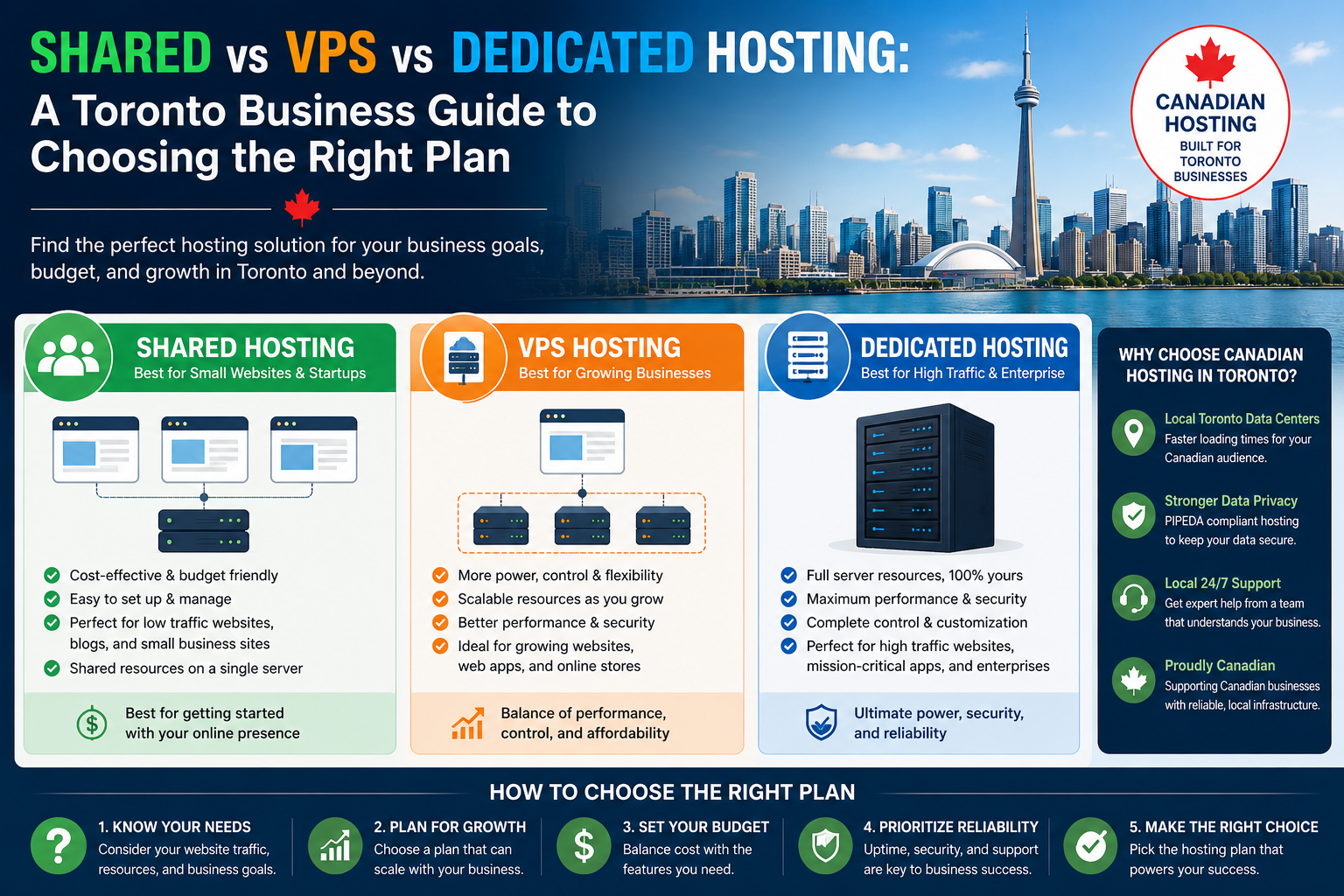
When a Toronto business sets out to choose web hosting, the first wall it hits is usually a menu of plan types with unfamiliar names: shared hosting, VPS, dedicated servers, and cloud. The labels sound technical, the differences are not obvious, and the temptation is to pick whichever is cheapest and hope for the best. That instinct is understandable but costly, because the plan type you choose determines how your site performs, how much room it has to grow, how much control you have, and how much you pay — and the right answer changes as your business does.
This guide demystifies the choice. We will explain what each hosting tier actually is, in plain language, along with its strengths, its limitations, and the kind of business it suits best. We will look at how to recognize which tier you need now, how to know when it is time to move up, and how the Canadian and Toronto context shapes the decision — because for local businesses, choosing web hosting Toronto plans well means weighing tier and location together. By the end, you will be able to read any provider’s plan menu with confidence and choose the Toronto web hosting tier that fits your business today while leaving room for tomorrow.
Before going deep, it helps to see the landscape. There are four main hosting tiers, and they exist on a spectrum from most shared and most affordable to most exclusive and most powerful. The table below summarizes how they compare across the factors that matter most.
| Factor | Shared | VPS | Dedicated | Cloud |
| Resources | Shared with others | Reserved slice | Entire server | Elastic pool |
| Cost | Lowest | Moderate | Highest | Usage-based |
| Performance | Good for light sites | Strong, consistent | Maximum | Scales on demand |
| Control | Limited | Significant | Full | Flexible |
| Best for | New / small sites | Growing sites | High-traffic sites | Variable traffic |
The pattern is straightforward: as you move from shared toward dedicated, you gain resources, performance, and control while paying more, and cloud sits alongside the others as a flexible model that scales with demand. Most businesses do not need the most powerful tier; they need the one that matches their actual workload. The sections that follow explain each tier in the detail you need to place your own business correctly on this spectrum.
Shared hosting is where most websites begin, and for good reason. It is the most affordable and the simplest way to get a site online, which makes it the natural entry point for new and small businesses.
On a shared plan, your website lives on a server alongside many other websites, all drawing from the same pool of resources — processing power, memory, and storage. Think of it as an apartment building: you have your own space, but you share the building’s infrastructure with everyone else. The provider manages the server, so you do not need technical expertise to get started. For a brochure site, a small business website, or a new venture finding its feet, this arrangement is often perfectly adequate.
The appeal of shared hosting is its low cost and ease of use. Because the expense of running the server is spread across many customers, the price per site is low, frequently just a few dollars a month. It typically comes with a user-friendly control panel and one-click installers, so launching a site is quick and approachable. For a business whose website has modest traffic and straightforward needs, this tier delivers genuine value without demanding any server administration.
The trade-off is in the sharing itself. Because resources are pooled, a sudden surge of traffic to another site on the same server can slow yours — the so-called noisy-neighbour problem. Shared plans also impose limits on resources and offer less control over server configuration, and budget providers sometimes oversell capacity, packing too many sites onto a single machine. For a low-traffic site these constraints rarely bite, but as your traffic and ambitions grow, they become more noticeable, and eventually they signal that it is time to move up a tier.
Shared hosting is the right starting point for new businesses, small brochure or portfolio sites, and any project with light, predictable traffic and a tight budget. For many Toronto small businesses, a quality entry-level plan — ideally on Canadian servers for speed and data residency — is all they need for a long time. The key is choosing a reputable provider that does not oversell, so you get the affordability of a shared plan without the slowdowns that give cheap plans a bad name.
When a site outgrows shared hosting but does not yet need an entire server, VPS hosting fills the gap. It is the natural next step for growing businesses, and for many it is the sweet spot between cost and capability.
VPS stands for virtual private server. A single physical server is divided into several virtual servers, each with its own reserved allocation of resources that no other customer can touch. Returning to the housing analogy, a VPS is like owning a condo: you still share the building, but your unit is genuinely yours, with guaranteed space and far more control over what happens inside it. Your performance no longer depends on what your neighbours are doing, because your slice of the server is reserved for you alone.
The advantages of VPS hosting centre on consistency and control. Because your resources are dedicated rather than pooled, performance is stable and predictable even when other sites on the physical server get busy. You also gain significantly more control over configuration, the ability to install software your site needs, and room to handle higher traffic. A VPS scales more gracefully than a shared plan, so a growing site can expand its resources without a disruptive move. For businesses whose websites have become important revenue drivers, this reliability is well worth the step up in price.
A VPS costs more than shared hosting and can involve more technical management, particularly on an unmanaged plan where you are responsible for server administration. This is where managed VPS options matter: a managed plan hands the technical upkeep back to the provider, giving you the power of a VPS without needing to be a system administrator. For a Toronto business without in-house technical staff, choosing managed VPS hosting captures the benefits while keeping the complexity at arm’s length.
VPS hosting suits growing businesses, sites with steady or rising traffic, online stores that have moved beyond the smallest scale, and any site that has started to feel constrained on an entry-level plan. It is also a strong choice for businesses that need specific software or configurations a shared plan will not allow. For many Toronto companies, a managed VPS on Canadian infrastructure is the tier where their website truly comes into its own — fast, reliable, and ready to grow.
At the top of the traditional spectrum sits dedicated hosting, where an entire physical server is yours alone. It offers the most power, the most control, and the highest cost, and it suits a specific kind of business need.
With a dedicated server, you lease an entire physical machine exclusively for your website or websites — no sharing of any kind. In housing terms, this is owning the whole building. Every resource the server has is available to you, and you have full control over its configuration. This exclusivity delivers the maximum performance a single server can provide and the ability to tailor the environment precisely to your needs.
The benefits of dedicated hosting are peak performance, complete control, and strong security isolation. Because no other customers share the machine, there is no competition for resources and no risk from a neighbour’s site. For high-traffic websites, demanding applications, or businesses with strict performance or compliance requirements, a dedicated machine provides headroom and reliability that lower tiers cannot match. It is the choice when your website is mission-critical and nothing less than full resources will do.
Dedicated hosting is the most expensive tier and, on an unmanaged basis, the most technically demanding, since you are responsible for an entire server. As with VPS, managed dedicated options exist, letting the provider handle administration while you enjoy the power. The honest reality is that most small and mid-sized businesses do not need an entire server — it is overkill for typical traffic levels, and the money is usually better spent elsewhere until your scale genuinely demands it.
Dedicated hosting suits large, high-traffic websites, resource-intensive applications, businesses with stringent security or compliance needs, and organizations running multiple demanding sites. For a Toronto enterprise whose website handles substantial volume or sensitive workloads, dedicated hosting on Canadian infrastructure offers maximum performance with the added benefits of data residency and local support. For everyone else, it is a tier to grow into rather than start with.
Alongside the three traditional tiers sits cloud hosting, a model defined less by a fixed allocation of resources and more by flexibility. Rather than living on a single machine, a cloud-hosted site draws on a pool of connected servers, scaling up or down as demand changes.
The defining strength of cloud hosting is elasticity. When traffic spikes, the site can automatically draw on more resources; when it subsides, it scales back, and you typically pay for what you use. This makes cloud hosting well suited to businesses with variable or unpredictable traffic — a site that experiences seasonal rushes, viral spikes, or rapid growth benefits from infrastructure that expands to meet demand without a manual upgrade. The pooled nature also offers resilience, since the failure of one underlying server need not take the site offline.
The trade-offs are that costs can be less predictable than a fixed monthly plan, since they vary with usage, and cloud setups can be more complex to manage. For many Toronto businesses, the practical sweet spot is a managed cloud or VPS arrangement that delivers flexibility and resilience while keeping the administration and the data on Canadian infrastructure. Cloud hosting is less a rung on the ladder than a parallel option worth considering when your traffic is genuinely variable.
Cutting across all four tiers is a second, equally important decision: managed or unmanaged. The tier determines how much resource and isolation you get; the management model determines who looks after the server. The two choices combine — you can have a managed VPS, an unmanaged dedicated server, and so on.
On an unmanaged plan, the provider supplies the infrastructure and leaves the administration to you: updates, security, configuration, and troubleshooting are your responsibility. This offers maximum control and a lower price, but it requires real technical skill and time. On a managed plan, the provider handles that technical upkeep — keeping the server updated, secure, optimized, and monitored — so you can focus on your business rather than on system administration.
For most Toronto businesses without dedicated IT staff, managed plans are the better choice at every tier, because the time saved and the problems avoided easily outweigh the modest premium. The managed model turns a VPS or dedicated server from a technical project into a simple, powerful hosting product. When comparing web hosting Toronto providers offer, look not just at the tier but at whether a managed version is available, because for many businesses that option is what makes a higher tier practical at all.
Whichever tier you are considering, the plan will list specifications that can be opaque at first glance. Learning to read them turns a confusing comparison into a clear one. A handful of figures tell you most of what you need to know.
Reading specifications this way lets you compare plans on substance rather than marketing. Two plans at the same price can differ enormously once you look past the headline and examine the storage type, the resource allocation, and what is actually included. The best Toronto web hosting value is rarely the plan with the biggest numbers or the lowest price, but the one whose real specifications match what your site needs. When a provider states these figures plainly, it is usually a sign of an honest, capable host worth your consideration.
With the tiers understood, the practical question is which one fits your business right now. A few honest signals point the way.
The most common mistake is over-buying out of caution or under-buying out of frugality. The right approach is to match the tier to your real workload, then choose a provider with a clear upgrade path so you can move up smoothly when your needs change. You do not have to predict the future perfectly; you only have to choose well for now and keep room to grow.
Hosting needs are not static. A site that fits comfortably on shared hosting today may strain it in a year, and the signs that you have outgrown a tier are usually clear: pages slow down, especially under traffic; you hit resource limits; your site struggles during busy periods; or you need capabilities your current plan cannot provide. When these appear consistently, it is time to move up.
The good news is that upgrading is far simpler than starting over, provided you chose a provider with a sensible ladder. Moving from shared to VPS, or VPS to dedicated, within the same provider is typically a smooth process the provider helps manage, often with little or no downtime. This is precisely why the upgrade path is such an important consideration when first choosing a host: a provider that offers the full range of tiers lets your hosting grow with your business rather than forcing a disruptive migration to a new company just as momentum builds. Choosing Toronto web hosting with room to scale is, in effect, future-proofing your foundation.
Whichever tier you choose, hosting it on Canadian infrastructure adds advantages that apply across the board. A shared plan, a VPS, a dedicated server, or a cloud setup all benefit from being located close to a Canadian audience: lower latency and faster page loads for local visitors, and data kept within Canadian jurisdiction for simpler privacy compliance.
This means the tier decision and the location decision are separate but complementary. You select the tier that matches your workload, and you select Canadian hosting to gain speed and data residency regardless of which tier that is. For a Toronto business, the strongest setup is the right tier on local servers — a managed VPS in Canadian data centres, for instance, rather than the same VPS hosted overseas. The performance and compliance benefits of local infrastructure stack on top of whatever tier your business needs, which is why web hosting Toronto companies rely on is best evaluated on both dimensions at once.
Abstract tiers become concrete when you see them applied. Consider three realistic Toronto businesses working through the same decision and arriving at different, well-reasoned answers.
The café is launching its first website — a few pages with the menu, hours, location, and a contact form. Traffic will be modest and local, and the budget is tight. For this business, a quality shared plan on Canadian servers is exactly right: affordable, simple to launch, and more than fast enough for a light site, with the local-server speed that helps it show up well for nearby searches. Starting here is sensible, and there is a clear path to move up if the café later adds online ordering and traffic grows. Choosing thoughtful Toronto web hosting at this stage costs little and sets a solid foundation.
The store has outgrown its first plan. Traffic has climbed, sales happen around the clock, and the site occasionally slowed during promotions on its old shared setup. This business needs the consistent, reserved resources of a managed VPS: stable performance under load, room to grow, and the security and reliability an e-commerce site demands — without the burden of administering the server itself. A managed VPS on Canadian infrastructure gives it speed for local shoppers, data residency for customer information, and headroom for the next stage of growth. The step up in cost is easily justified by the sales it protects.
This larger organization runs a high-traffic site with demanding applications and strict requirements around performance and data handling. For it, a dedicated server — or a robust cloud arrangement — on Canadian infrastructure makes sense: maximum resources, full control, strong isolation, and the data residency its compliance posture requires. The cost is significant, but so is the role the website plays, and at this scale the investment is proportionate. The web hosting Toronto enterprises of this kind need is simply different from what a café needs, which is exactly the point.
Three businesses, one decision framework, three correct answers. The lesson is not that any single tier is best, but that the right tier is the one matched honestly to the workload — and that hosting it locally benefits all three regardless of which tier they chose.
Cost naturally rises as you move up the tiers, but the right way to think about price is value rather than the lowest number. Shared hosting is cheapest but offers the least headroom; dedicated is most expensive but provides the most power; VPS and cloud sit in between, each offering a particular balance. The goal is not to spend the least or the most, but to pay for the tier your business actually needs — no more, no less.
Two cautions help here. First, beware the false economy of under-buying: a shared plan that constantly slows under your traffic costs you in lost conversions even though its monthly fee is low. Second, beware over-buying: paying for a dedicated server when a managed VPS would serve you well is money that could be better spent elsewhere. Factor in the management model too, since a managed plan’s premium buys back time and prevents problems. Measured by total value rather than sticker price, the right tier is usually obvious once you have matched it honestly to your workload.
Beyond the four core tiers, providers often offer specialized plans built around a particular use case. These are not separate tiers so much as tailored versions of them, and a few are worth understanding because they may fit your situation better than a generic plan.
Because so many business sites run on WordPress, many providers offer hosting optimized specifically for it — with WordPress-tuned caching, automatic updates, and platform-aware security built in. This is usually a managed offering layered on shared or VPS-grade resources, and for a WordPress site it often outperforms a generic plan of the same tier while removing maintenance work. If your site runs on WordPress, this specialized option is well worth comparing against a standard plan.
Online stores have particular needs — strong performance under traffic spikes, robust security for payment data, and reliability during sales — and some providers package plans around them. Whether built on VPS or cloud resources, e-commerce-focused hosting bundles the speed, security, and headroom an online store depends on. For a Toronto retailer selling online, a plan designed for commerce on Canadian servers can be a better fit than a general-purpose tier.
For agencies, freelancers, and businesses that manage websites on behalf of others, reseller hosting allows you to host multiple client sites under one account and even rebrand the service as your own. It is a specialized model aimed at those who manage many sites rather than one, and it can be an efficient way to consolidate that work with a single Canadian provider. If you build or maintain sites for clients, it is worth asking whether reseller plans are available.
The takeaway is that the four tiers are the foundation, but specialized plans can refine the fit. When evaluating web hosting Toronto providers offer, ask whether a plan tailored to your platform or use case exists, because the right specialization can deliver better results than a generic plan at the same price point.
A few recurring errors lead businesses to the wrong tier, and avoiding them is straightforward once you know what to watch for.
Steer clear of these and the decision becomes much simpler: match the tier to your workload, choose managed unless you have the expertise to go without, confirm a clear upgrade path, and host on Canadian infrastructure for the speed and sovereignty benefits that apply at every tier.
On shared hosting, your site shares a pool of resources with many other sites on the same server, so a busy neighbour can affect your performance. On a VPS, you get a reserved, guaranteed slice of a server that no one else can touch, giving you more consistent performance and far more control. VPS costs more but is the natural step up when shared hosting starts to feel constrained.
Most small and mid-sized businesses do not. A dedicated server is best for high-traffic sites, demanding applications, or strict security and compliance needs. For typical business websites, a quality shared plan or a managed VPS delivers excellent performance at a fraction of the cost. A dedicated server is usually a tier to grow into rather than start with.
If you have the technical skill and time to administer a server, unmanaged offers more control at a lower price. For most businesses without in-house IT, managed is the better choice at any tier, because the provider handles updates, security, and maintenance, freeing you to focus on your business. The modest premium typically pays for itself in saved time and avoided problems.
Yes, and it is a sensible approach. Start on the tier that fits your current traffic and budget, and choose a provider that offers the full range of plans so you can move up smoothly as you grow. Upgrading within the same provider is usually straightforward and low-disruption, which is why the upgrade path matters so much when first choosing a host.
It can, especially under load. A light site on a good shared plan may be plenty fast, but as traffic grows, shared resources can become a bottleneck, while a VPS or dedicated server provides consistent performance. Speed also depends heavily on server location and quality, so for a Toronto audience, pairing the right tier with Canadian servers gives you both consistent resources and low latency.
It can, especially under load. A light site on a good shared plan may be plenty fast, but as traffic grows, shared resources can become a bottleneck, while a VPS or dedicated server provides consistent performance. Speed also depends heavily on server location and quality, so for a Toronto audience, pairing the right tier with Canadian servers gives you both consistent resources and low latency.
A VPS gives you a fixed, reserved slice of a single physical server. Cloud hosting instead draws on a pool of connected servers, so it can scale resources up or down automatically as demand changes, and you typically pay for what you use. A VPS offers predictable cost and performance; cloud offers flexibility and resilience for variable traffic. The best choice depends on how steady or spiky your traffic is.
The signs are usually clear: pages slow down, especially during busy periods; you hit resource limits; your site struggles under traffic; or you need capabilities your current plan cannot provide. When these appear consistently, it is time to move up a tier. With a provider that offers the full range of plans, upgrading is typically smooth and low-disruption, which is why choosing a host with room to grow matters from the start.
Often yes, depending on the plan and its resources. Many shared and VPS plans allow multiple websites or domains under one account, while a dedicated server can host as many as its resources support. If you run several sites or expect to, ask providers specifically about multi-site limits and whether resources are shared across them or allocated per site, since that affects both cost and performance.
Usually yes — most providers offer managed versions of shared, VPS, and dedicated plans, and often cloud as well. The management model is a separate choice from the tier, so you can pair the resource level you need with the amount of hands-on administration you want. For most businesses without in-house IT, a managed version of whichever tier fits is the practical choice.
Location and tier are separate decisions that work best together. You choose the tier to match your workload and the location to match your audience. For a Toronto business, hosting whatever tier you select on Canadian servers adds lower latency for local visitors and keeps data within Canadian jurisdiction — benefits that apply equally to shared, VPS, dedicated, and cloud plans. So pick the tier on its merits, and then host it locally for the best of both.
Choosing between shared, VPS, dedicated, and cloud hosting comes down to matching the tier to your business’s real needs rather than chasing the cheapest price or the most powerful option. Shared hosting is the affordable starting point for new and small sites; VPS is the reliable middle ground for growing businesses; dedicated hosting delivers maximum power for demanding, high-traffic sites; and cloud offers flexibility for variable workloads. Layered over all of them is the managed-versus-unmanaged choice, which for most businesses points toward managed for the time and peace of mind it buys.
For a Toronto business, the smartest approach is to choose the tier that fits your workload today, on Canadian infrastructure for the speed and data-residency advantages that apply regardless of tier, with a provider that offers a clear path to grow. Get that combination right and your hosting becomes a foundation that supports your business now and scales alongside it later. The best Toronto web hosting decision is rarely the cheapest or the most powerful — it is the one that fits your workload today, on Canadian infrastructure for the speed and data residency that benefit every tier, with room to grow comfortably when your business does.Find the right Toronto web hosting plan on Canadian servers →
 October 7, 2026Canadian Hosting, SEO, Web Hosting Canada
 October 7, 2026Canadian Hosting, Windsor Web Hosting
 October 7, 2026Canadian Hosting
 October 6, 2026Canadian Hosting
 October 6, 2026Canadian Hosting, St. John's web hosting
 September 30, 2026Canadian Hosting, Web Hosting Canada