
 August 25, 2026
 Uncategorized
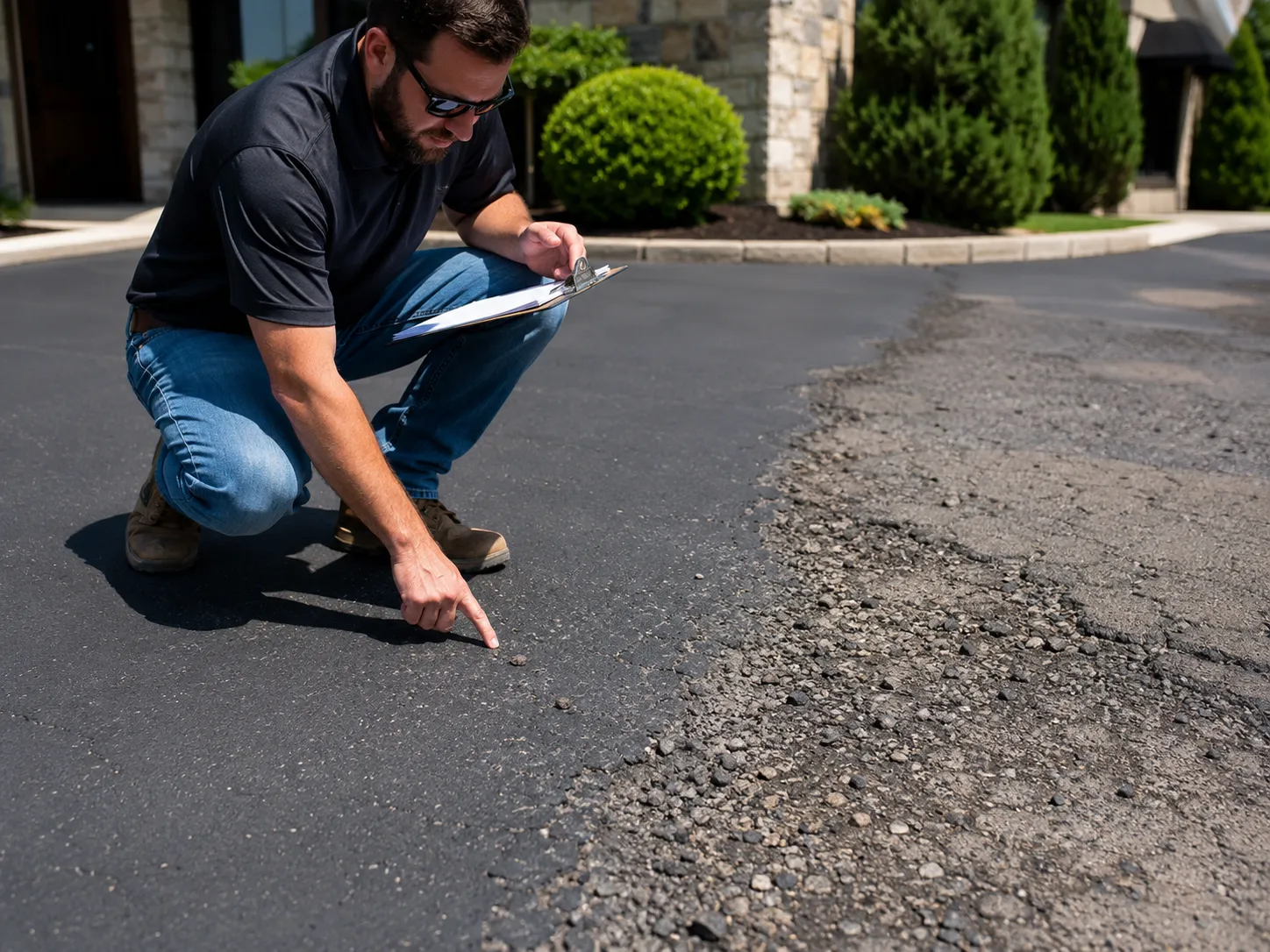 Raveling is the wearing away of an asphalt surface as the binder loses its grip and aggregate particles work loose. The Federal Highway Administration describes its progression in three stages: first the fine material goes, then some of the coarse aggregate, and eventually the surface becomes rough and pitted with obvious aggregate loss.
Property owners almost always ask the wrong question about it. The question is not how bad does this look — it is how deep does the binder failure go, and why did it start. A pavement can look alarming and need only a surface treatment. Another can look mildly gritty and need to come out entirely. Asphalt raveling repair therefore starts with a diagnosis rather than a quote, and this guide covers how professionals actually make that call.
In Edmonton this distinction matters more than almost anywhere. After a winter of traction sand and plowing, loose aggregate on asphalt is normal in spring — and most of it was put there, not shed by the pavement.
Three quick checks separate the two:
If sweeping reveals a closed surface, you have housekeeping. If it reveals pitting, keep reading.
ASTM D6433 — the standard governing pavement condition surveys for roads and parking lots — attributes raveling to five causes: insufficient asphalt binder, poor mixture quality, insufficient compaction, segregation, and stripping.
That list is the whole diagnosis, because the causes sit at different depths.
| Cause | Where the defect lives | What that usually means |
|---|---|---|
| Insufficient binder | Throughout the lift as placed | The lift is deficient; surface treatment buys little time |
| Poor mixture quality | Throughout the lift | Removal and replacement of the affected area |
| Insufficient compaction | Throughout the lift, often worse at edges and joints | Mill and replace; check joints and perimeter |
| Segregation | Localized streaks or patches where coarse material separated during placement | Targeted removal of the affected areas |
| Stripping | Binder–aggregate bond failing from moisture, can extend into lower lifts | Investigate depth before choosing anything |
Notice what is not on that list: ordinary age. A well-built asphalt surface does eventually oxidize, stiffen, and begin shedding fines, and that kind of wear genuinely is surface-confined. But four of ASTM’s five causes are defects built into the pavement when it was placed — which is why the age of your pavement is one of the most diagnostic facts you have.
ASTM D6433 grades raveling on dense-mix asphalt by counting. Within a representative one-square-metre area:
| Severity | Missing coarse aggregate pieces | Or, missing aggregate clusters |
|---|---|---|
| Low | 5–20 | Under 2% of the examined area |
| Medium | 21–40 | 2–10% of the examined area |
| High | More than 40 | More than 10% of the examined area |
An aggregate cluster means more than one adjoining stone missing. The standard’s own advice when a rating is uncertain is to examine three representative one-square-metre areas and count each, rather than judging by eye from standing height.
You can do this yourself in ten minutes with a tape measure and chalk. It converts “the lot looks rough” into a number a contractor has to engage with.
The FHWA’s Long-Term Pavement Performance program takes a different approach, and it is the more revealing one. Under LTPP’s survey directive, raveling is assigned no severity levels at all. The reasoning is stated plainly: the presence of raveling indicates potential mixture-related performance problems, and the extent is recorded simply to monitor progression. Surveyors record the affected area in square metres.
Read that again, because it inverts the intuition most owners bring. Under the federal standard, raveling showing up at all is the finding. Severity is secondary.
The practical consequence: a small patch of raveling on a four-year-old parking lot is a more serious result than a large area on a twenty-year-old one. The first says something went wrong in the mix or the placement. The second says the pavement is old.
Put the count, the area, the pavement’s age, and any accompanying distresses together, and the answer usually resolves cleanly.
| What you’re seeing | Likely reading | Typical direction |
|---|---|---|
| Low count, pavement past 12–15 years, no cracking, tight base | Age-related surface oxidation | Surface treatment or sealcoat; monitor |
| Sharp-edged streaks or patches that look coarser than the surface around them | Segregation during placement | Mill and replace those areas only |
| Raveling concentrated along edges, joints, or the perimeter | Compaction shortfall where rollers couldn’t reach | Joint and edge repair, not full replacement |
| Widespread raveling on pavement under 5 years old | Mix, binder, or compaction defect | Removal and replacement — and a warranty conversation |
| Raveling plus alligator cracking, rutting, or depressions that hold water | The base or subgrade is involved | Full-depth investigation before any surfacing |
| Raveling that returns within a season of being sealed | Stripping progressing below the surface | Core the pavement before spending again |
Surface wear asphalt repair options fall into three tiers, and matching the tier to the diagnosis is the entire point: sealcoating or a surface treatment for genuine surface-confined wear; milling and overlaying where the failure is confined to the top lift; and full-depth removal and repaving where it is not.
Sealing a pavement that is stripping from below is the most common and most expensive mistake in this category. It looks fixed for one season.
Everything above is a surface inspection, and a surface inspection cannot see depth. A core sample can. It is a small-diameter cylinder cut through the pavement, and for a raveling question it settles four things that no amount of looking can:
Coring costs a fraction of a repave and is worth it whenever the answer would change the recommendation — particularly when raveling has returned after treatment, when the pavement is young, or when other distresses are present. A contractor who recommends full replacement without ever proposing a core is asking you to buy their guess.
Freeze-thaw frequency. Edmonton’s pavements cross the freezing point far more often than the winter temperature average suggests. A City of Edmonton roads official reported roughly 30 freeze-thaw cycles in a single season by early spring, and a City report in March 2026 tied lagging pothole repair performance directly to increased precipitation and frequent freeze-thaw cycles. For a raveling surface this is the critical mechanism: an open, pitted surface admits water, and water is what drives stripping. Raveling and freeze-thaw feed each other.
Winter maintenance abrasion. Traction sand and plow blades work directly on the wearing course. This does not usually cause raveling in a sound pavement, but it will unmask and accelerate a marginal one.
Local subgrade conditions. Parts of the Edmonton area sit on lacustrine clay, and clay subgrades hold moisture and move seasonally. Where raveling appears alongside depressions or cracking, this is worth a geotechnical opinion rather than a guess — surfacing over a moving base fails quickly regardless of how good the new asphalt is.
Season. Paving is temperature-dependent, so a diagnosis made in late fall often means a spring booking. That makes autumn the right time to get the assessment done, not the right time to discover you needed one.
Each of these has a specific answer. Vagueness is itself the finding.
Can raveling be repaired without repaving?
Yes, when the failure is confined to the surface. Genuine age-related oxidation on an otherwise sound pavement responds to sealcoating or a surface treatment, and localized segregation streaks can be milled out and replaced without touching the rest of the lot. Repaving becomes the answer when the defect runs through the full lift or the base is involved.
How do I know if my asphalt is raveling or just shedding winter sand?
Sweep a test square. Traction sand sweeps away and leaves a closed surface; raveling leaves visible sockets where aggregate has come out. Loose aggregate on asphalt that carries dark binder on one face came out of the pavement.
Is raveling covered by a paving warranty?
It depends on the terms and on the cause. Four of the five recognised causes — insufficient binder, poor mixture quality, insufficient compaction, and segregation — are placement and materials issues rather than wear, which is why widespread raveling on young pavement warrants a warranty conversation. Check your contract’s specific language.
Does sealcoating fix raveling?
It addresses surface-confined wear and slows moisture entry. It does not fix a deficient mix, poor compaction, or stripping below the surface. Sealing over those causes typically buys one season.
What is stripping, and why does it matter more in a cold climate?
Stripping is the loss of adhesion between binder and aggregate under the action of moisture. It matters in Edmonton because a raveled surface admits water and repeated freeze-thaw cycling drives it deeper, so a surface problem can become a structural one across a single winter.
How much of a parking lot needs to be raveling before repaving makes sense?
There is no universal percentage, and any contractor quoting one without measuring is guessing. The decision turns on cause and depth rather than area alone — which is why the age of the pavement and the presence of other distresses matter more than the square metres.
Asphalt raveling repair is a depth question, not an appearance question. Count the missing aggregate in a measured square metre, measure the total affected area, note the pavement’s age, and look for the distresses that travel with base failure. Widespread raveling on young pavement points at how it was built. A modest amount on old pavement points at time. Those two findings lead to very different invoices.
JAK Paving assesses and repairs asphalt surfaces for residential, commercial, and industrial properties across Edmonton, Spruce Grove, Stony Plain, and the surrounding area. If your surface is shedding aggregate and you want a diagnosis rather than a quote for the most expensive option, request an assessment — and bring your square-metre count.
 October 7, 2026Canadian Hosting, SEO, Web Hosting Canada
 October 7, 2026Canadian Hosting, Windsor Web Hosting
 October 7, 2026Canadian Hosting
 October 6, 2026Canadian Hosting
 October 6, 2026Canadian Hosting, St. John's web hosting
 September 30, 2026Canadian Hosting, Web Hosting Canada