
 August 26, 2026
 AI SEO Canada, Canadian Hosting, SEO, SEO & AI Search, SEO Keyword Research, Web Hosting Canada
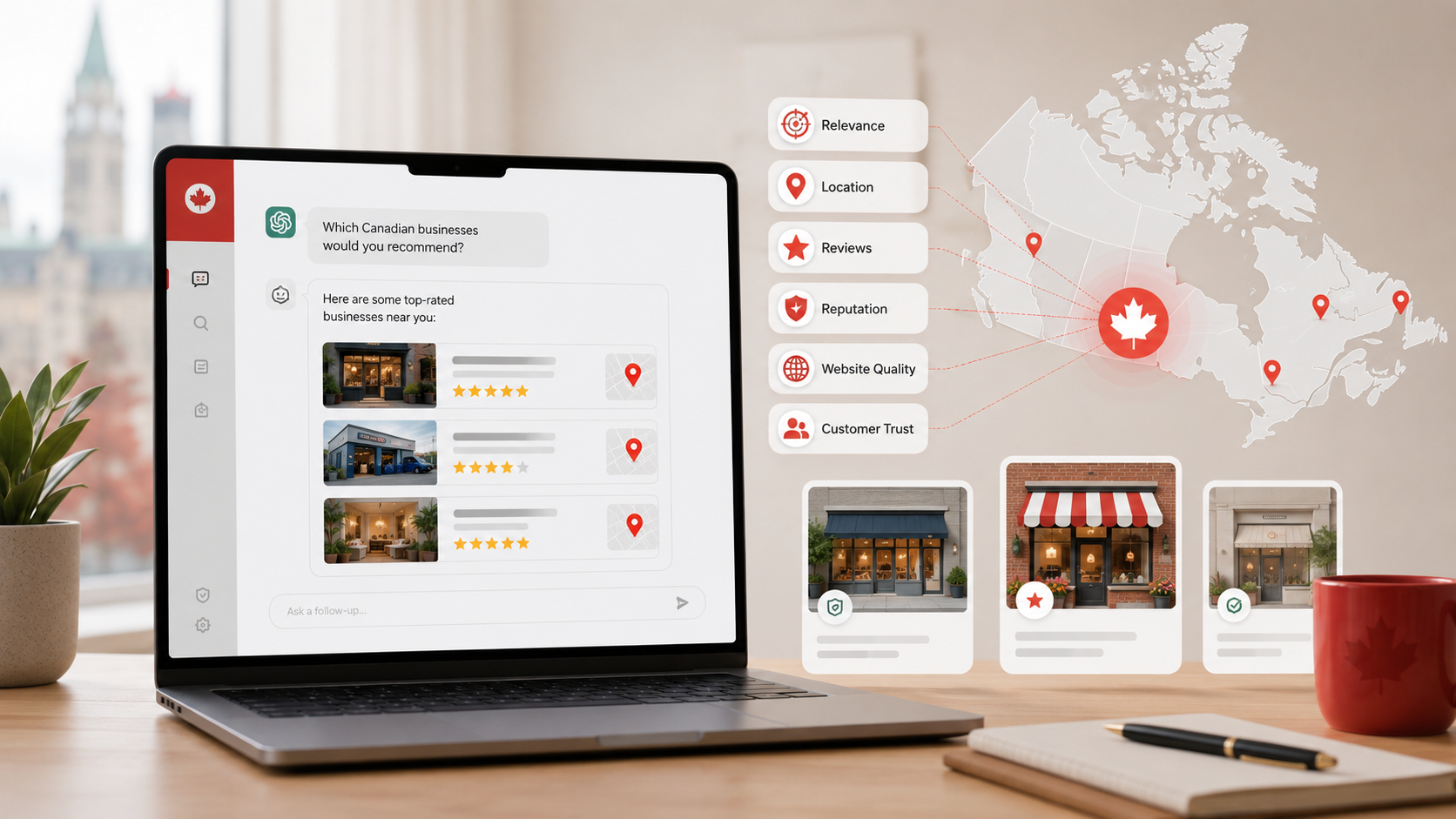 Every day, Canadians ask ChatGPT questions like “What’s the best digital marketing agency in Vancouver?” or “Who are the most reliable managed WordPress hosting providers in Canada?” and ChatGPT answers with specific business names. Some companies get recommended consistently. Most never appear at all.
The difference is not luck, and it is not about who spent the most on Google Ads. ChatGPT does not publish a fixed formula for choosing brands, and advertising does not influence its answers. What does matter is a set of signals that most Canadian businesses — and many SEO agencies — do not yet understand or act on.
In the second quarter of 2026, 19.2% of Canadian businesses reported using AI to produce goods or deliver services, a figure that has tripled since 2024. But using AI internally and being recommended by AI to potential customers are two completely different things. This article is about the second problem — the one with direct revenue consequences. ChatGPT business recommendations for business websites in Canada are increasingly the first touchpoint in a buyer’s research journey, and the businesses that appear in those recommendations consistently have advantages that compound over time.
What follows is a detailed, practical breakdown — and the foundation for effective AI search optimization in Canada for business growth of exactly how ChatGPT selects which Canadian businesses to recommend, how the mechanism differs from traditional Google SEO, what Canadian-specific factors the standard guidance ignores, and a step-by-step framework for improving your visibility in AI-generated recommendations. This is the guide the competitor articles do not write: not a product announcement, not a generic “create good content” list, but a technical and strategic explanation grounded in verified research and OpenAI’s own published documentation.
Before discussing what to optimise, it is worth being precise about the mechanism — because most of the advice currently circulating about “ranking in ChatGPT” is based on a misunderstanding of how ChatGPT works.
ChatGPT is not a search engine with a ranked list of businesses that it selects from. ChatGPT chooses which local businesses to recommend by retrieving live web pages when you ask, then synthesising an answer and linking the sources it used — not by ranking companies on a fixed list. The businesses that appear in the answer are the ones whose pages were retrieved and referenced during that specific query, in that specific session.
This retrieval-then-synthesis process has three sequential stages:
Stage 1 — Retrieval. When a user asks a question that requires current or specific business information, ChatGPT Search (powered by OAI-SearchBot and Bing’s index) fetches relevant web pages. Pages that cannot be retrieved — because they are blocked to crawlers, rendered entirely in JavaScript that AI crawlers cannot execute, or simply not indexed — are invisible at this stage, regardless of how good their content is.
Stage 2 — Synthesis. ChatGPT reads the retrieved pages and generates a natural-language answer. Businesses that are mentioned clearly, consistently, and with specific details across multiple retrieved sources get included. Businesses mentioned vaguely, contradictorily, or only on their own website frequently do not.
Stage 3 — Citation. ChatGPT links the pages it used to build the answer. The practical takeaway: a business can only be cited if a page containing its information was retrieved during that search. If your details are trapped in an image, a PDF nobody links to, or a login-gated portal, you are effectively invisible to this process.
The implication of this three-stage process is significant: ChatGPT cannot recommend you if it cannot read about you from sources it can actually access. Technical accessibility is not a technical nicety — it is the prerequisite for everything else.
Research and practitioner testing have identified the factors that correlate most strongly with appearing in AI-generated business recommendations. ChatGPT recommends brands that it has strong, clear associations with from training data and trusted sources — structured in a way it can confidently extract and attribute. Those associations are built through seven distinct signals.
Three factors dominate ChatGPT’s recommendation behaviour. First, entity clarity: ChatGPT needs to understand unambiguously what your business is, what it does, and where it operates. If your brand identity is unclear or conflicts with another entity, ChatGPT will typically default to better-defined competitors.
Entity clarity means ChatGPT has enough consistent, unambiguous information about your business to answer three questions without hesitation: What is the name of this business? What does it do? Where does it operate?
For Canadian businesses, this becomes more complex than it sounds. A Vancouver-based managed WordPress hosting provider that also has a US subsidiary, uses the same brand name as an Australian tech company, or describes its service area as “North America” rather than specifying Canadian provinces and cities is creating entity ambiguity that works against it. ChatGPT will confidently recommend the business with clearer geographic and categorical positioning.
The foundation of entity clarity is your NAP (Name, Address, Phone) data — which must be identical across your website, Google Business Profile, industry directories, the Canadian Chamber of Commerce listing, provincial business registries, and anywhere else your business appears online. A single address format difference (Suite 400 vs #400; Ontario vs ON) is enough to weaken ChatGPT’s entity confidence.
Schema markup accelerates this. LocalBusiness or Organization schema on your homepage — with name, address, telephone, url, areaServed (specify Canadian provinces), and description populated — gives ChatGPT’s crawlers machine-readable confirmation of exactly what your business is and where it operates. Clean LocalBusiness structured data (name, address, phone, hours, service area) makes your details easy to parse.
This is the most actionable signal and the one most businesses get wrong by accident.
OpenAI now documents three separate crawler or user-agent roles: GPTBot for training, OAI-SearchBot for ChatGPT search visibility, and ChatGPT-User for user-triggered fetches. These are three completely separate crawlers with completely separate permissions — and conflating them is costing Canadian businesses their AI visibility without their knowledge.
Blocking GPTBot has no measurable impact on Google Search rankings, but blocking OAI-SearchBot removes you from ChatGPT search answers entirely. The common scenario: a business or developer adds a broad Disallow: / rule in robots.txt to block all AI training crawlers for content protection reasons. This rule catches OAI-SearchBot alongside GPTBot and wipes out ChatGPT search visibility, while the business owner has no idea.
The correct robots.txt configuration if you want to be visible in ChatGPT answers while protecting your content from training:
User-agent: GPTBot
Disallow: /

User-agent: OAI-SearchBot
Allow: /
This allows OAI-SearchBot (ChatGPT search eligibility) while blocking GPTBot (training data collection). They are independent switches.
Beyond robots.txt, two other crawl barriers are common in Canadian business websites. The first is client-side rendering: 69% of AI crawlers cannot execute JavaScript. If your site relies on client-side rendering, AI bots see a blank page regardless of your robots.txt settings. A WordPress site with server-side rendering is inherently better positioned for AI crawlability than a heavily JavaScript-dependent headless build. The second is CDN-level bot rules: approximately 27% of B2B SaaS and ecommerce websites are accidentally blocking major LLM crawlers due to CDN-level rules, often without knowing it. Check your Cloudflare, Fastly, or AWS CloudFront bot management settings explicitly for OAI-SearchBot and PerplexityBot.
For Canadian businesses, hosting on Canadian infrastructure matters here for an additional reason. Canadian-hosted servers avoid the cross-border data transfer concerns under PIPEDA that can prompt security teams to implement broader AI crawler blocks, and they provide lower-latency responses to the OAI-SearchBot crawler, which may improve crawl frequency.
Your own website saying you are the best managed WordPress host in Canada means very little to ChatGPT. ChatGPT pulls from its training data and, for real-time queries, from web browsing via Bing. Businesses that appear most frequently and most authoritatively across the web — in reviews, news articles, industry directories, and cited content — are the ones ChatGPT surfaces when someone asks for a recommendation.
Third-party citations are the highest-leverage signal in the framework. A single mention of your business in a credible industry publication carries more weight than ten pages of self-published content, because the citation comes from a source ChatGPT already trusts.
For Canadian businesses, the highest-value third-party citation sources are:
Industry directories and business registries. The Canadian Chamber of Commerce member directory, provincial chambers, the Better Business Bureau Canada listing, and industry-specific professional body directories (the Canadian Marketing Association, CIRA’s listed registrars, provincial law society directories for legal firms) carry strong entity authority signals.
Local and national Canadian media. A mention in the Globe and Mail, National Post, CBC.ca business section, BNN Bloomberg, or a regional business publication like Business in Vancouver or Toronto Star Business is substantially more valuable than a mention in a US-market publication because it establishes both credibility and Canadian geographic specificity.
Review platforms with Canadian relevance. Google Reviews, Clutch.co (which has strong Canadian agency presence), G2 for software businesses, and Trustpilot — but with Canadian addresses and reviews from verifiably Canadian clients where possible. The geographic signal in reviews matters: a review from a Toronto client reinforces your Canadian entity positioning in a way that a generic review from an unidentified location does not.
Peer coverage and digital PR. Guest articles in Canadian business publications, being interviewed or quoted in industry roundups, and being named in “best of Canada” lists create the multi-source corroboration that gives ChatGPT confidence to recommend you.
The companies that show up most often in AI recommendation answers share a pattern: they have clear positioning, strong third-party presence, and are well documented across the digital ecosystem.
If someone asks ChatGPT for a recommendation in your industry, it looks for businesses that have demonstrated expertise in that specific area. A law firm with 20 detailed articles about employment law is more likely to appear in an employment law recommendation than a firm with a single generic practice areas page.
This is what AI SEO services for Canadian businesses in 2026 increasingly focus on: not just keyword optimisation, but genuine topical authority built through depth of coverage. ChatGPT’s retrieval system favours pages that provide clear, specific, extractable answers over pages that use broad, generic language.
For AI search, content needs to be structured for extraction, not just for human reading. That means:
Content frequency matters alongside depth. A business that publishes two detailed, well-structured articles per month builds topical authority faster than one that publishes ten thin posts on the same schedule. ChatGPT’s retrieval system rewards freshness as well as depth: recently published content that addresses current questions carries a recency advantage in web-search queries.
Schema markup is the most direct way to communicate structured facts to ChatGPT’s retrieval system. While schema does not “force” a recommendation, it dramatically reduces the ambiguity that causes ChatGPT to skip a business in favour of one it can parse more easily.
The schema types most relevant to Canadian businesses seeking ChatGPT recommendations are:
LocalBusiness or Organization with name, address (using Canadian province codes and postal codes, not state abbreviations), telephone (with +1 Canadian country code), url, areaServed populated with specific Canadian provinces or cities, description, and sameAs pointing to your Google Business Profile, LinkedIn, Canadian Chamber of Commerce listing, and other authoritative directory pages.
FAQPage for pages that contain question-and-answer content. ChatGPT frequently uses FAQ content as direct citation material because the Q&A structure maps cleanly onto conversational query-and-answer format.
Service or Product markup for your specific offerings, with Canadian pricing in CAD where applicable. Specifying “CAD” rather than “$” matters because it removes currency ambiguity for a Canadian-market context.
Review and AggregateRating from verified Canadian customers, where schema is supported by the review platform. Star ratings and review counts contribute to credibility signals.
One Canadian-specific structured data consideration: if your business serves both English and French markets, use hreflang tags correctly to declare the language-specific versions of your pages, and consider adding inLanguage to your Article or Service schema to declare the content language explicitly.
ChatGPT’s recommendations can change frequently because of its real-time search capability. New content, updated directory listings, fresh reviews, and recent third-party mentions can all influence what ChatGPT recommends within days or weeks.
This has an important practical consequence: AI visibility is not a one-time fix, it is an ongoing maintenance task. Canadian businesses that invest in AI SEO services need to treat the following as recurring activities, not one-time projects:
Most guides on ranking in ChatGPT were written for US or global markets, and they do not account for the specific requirements of AI SEO services for business websites in Canada. They miss several factors that matter specifically for how Canadian businesses can rank in ChatGPT recommendations.
Bilingual entity consistency. If your business serves French-speaking customers in Quebec or across Canada, your entity information needs to be consistent in both languages. A business name or description that differs between your English and French pages creates ambiguity that ChatGPT cannot resolve confidently. Your French-language pages should carry the same schema markup as your English pages, with inLanguage: "fr-CA" specified.
Canadian geographic specificity. “Serving Canada” is too vague. “Serving small businesses in British Columbia, Alberta, Ontario, and Quebec with managed WordPress hosting from our Vancouver and Toronto data centres” is the kind of specific, verifiable geographic claim that ChatGPT can confidently cite when someone asks for a Canadian hosting provider. Province-level and city-level specificity dramatically outperforms country-level descriptions.
PIPEDA and privacy compliance signals. Canadian businesses in industries where data privacy matters — healthcare, finance, legal, HR, and marketing technology — should make PIPEDA compliance explicit and verifiable on their websites. The Office of the Privacy Commissioner’s 2026 investigation into OpenAI’s training practices underscores that Canadian privacy law is a live and enforced framework. A business that clearly documents its PIPEDA compliance, its data residency (especially “Canadian data centres” for hosting and SaaS providers), and its privacy policy in machine-readable terms is positioning itself as a lower-risk recommendation for ChatGPT when the query has any regulatory dimension.
Canadian institution references. Using Canadian institutional vocabulary — CRA instead of IRS, GST/HST instead of generic sales tax, Canadian postal codes rather than ZIP codes, provincial regulatory body names — signals Canadian geographic authenticity to ChatGPT’s retrieval system in a way that generic content does not. A page about “business tax deductions” that references the T2125 form and CRA filing deadlines is unambiguously Canadian; a page about “business tax deductions” that could have been written in any English-speaking market is not.
Understanding why the ChatGPT recommendation mechanism is different from Google ranking helps avoid the common mistake of applying SEO tactics that work for one system to a system with different architecture.
Google ranks pages. ChatGPT cites sources. The difference is consequential.
In Google SEO, ranking first for a keyword means your page appears at position one in the search results. The user then decides whether to click. Your page does not need to directly answer the question; it needs to signal to Google that it is the most authoritative result for the keyword.
In ChatGPT recommendations, the user receives a synthesised answer, not a list of links. ChatGPT reads multiple pages and combines information into a single response. Your page needs to provide specific, extractable, verifiable facts that ChatGPT can incorporate into that synthesised answer. Rather than chasing supposed ChatGPT ranking factors, the better approach is to make a business as easy as possible to find, understand and verify across the web.
This means backlinks matter less in ChatGPT citations than in Google ranking. Domain authority scores are not what ChatGPT measures. Meta description optimisation has no direct ChatGPT citation effect. What matters is whether ChatGPT’s retrieval system can find a clear, current, and consistent description of your business from multiple independent sources — and whether the page that contains your business information is technically accessible to AI crawlers.
The table below summarises the key differences:
| Factor | Google SEO importance | ChatGPT citation importance |
|---|---|---|
| Backlink count and authority | Very high | Low — directional at best |
| Keyword density and placement | High | Low — semantic match matters, not density |
| Entity consistency (NAP, schema) | Medium | Very high — prerequisite |
| Third-party citations and mentions | Medium (backlinks) | Very high (corroboration) |
| Crawl access (OAI-SearchBot) | Not applicable | Critical — blocking = invisible |
| JavaScript rendering | Low (Google renders JS) | High — most AI crawlers do not |
| Content freshness | Medium | High — real-time retrieval rewards recency |
| Review volume and recency | Local SEO factor | High — third-party trust signal |
| Bilingual content (Canada) | Medium for fr-CA | High — entity clarity across languages |
Use this checklist to audit your current AI visibility position. Each item maps to one of the seven signals described above.
Entity Clarity
LocalBusiness or Organization schema is implemented with areaServed specifying Canadian provincessameAs links point to Google Business Profile, LinkedIn, Canadian Chamber of Commerce, and industry registry listingsCrawl Access
OAI-SearchBot (separate from GPTBot setting)Third-Party Citations
Content Quality
Structured Data
hreflang correctly implemented for bilingual sitesFreshness
Before optimising for ChatGPT, you need to understand your current entity consistency across the web. Search for your business name on ChatGPT directly and observe what it says — whether it mentions you at all, how it describes you, and whether the description is accurate. Then search Google for "[your business name]" site:yelp.com OR site:bbb.org OR site:yellowpages.ca OR site:clutch.co to find your existing directory presence.
Document every inconsistency: a different phone number format here, a different address abbreviation there, a service description that no longer matches your current offerings. These inconsistencies are your highest-priority fixes because entity ambiguity is the most fundamental barrier to ChatGPT recommendations.
Check your robots.txt file at yourdomain.ca/robots.txt. If you see User-agent: * with a broad Disallow: /, or if you see User-agent: GPTBot with a Disallow: / but no separate OAI-SearchBot rule, your ChatGPT search visibility is compromised.
Add explicit allow rules for the search crawlers:
User-agent: OAI-SearchBot
Allow: /

User-agent: PerplexityBot
Allow: /

User-agent: Claude-SearchBot
Allow: /
Then check your CDN’s bot management configuration and confirm these user agents are not included in any “block AI bots” rule. Verify the fix by checking server logs for OAI-SearchBot activity within two to three weeks.
Add or update your Organization or LocalBusiness JSON-LD schema. For a Canadian business, ensure addressRegion uses the two-letter Canadian province code (ON, BC, AB, QC, etc.), addressCountry is set to “CA”, telephone includes the country code (+1), and areaServed lists the specific provinces or cities you serve.
Add sameAs links to every authoritative external profile where your business appears: Google Business Profile, LinkedIn company page, BBB Canada, Canadian Chamber of Commerce, and any industry registry. This network of sameAs links is the structured-data equivalent of third-party citations — it tells ChatGPT’s crawlers that all of these external profiles refer to the same entity as your website.
Prioritise Canadian sources in this order:
For each core service page, add or improve these elements:
Run your core commercial prompts through ChatGPT, Perplexity, and Google AI Overviews monthly. This is how you measure your ability to rank in ChatGPT Canada for business growth — not through a third-party score, but through direct observation of what the system actually surfaces. Log whether you appear, how you are described, which sources are cited, and whether competitors appear instead of you. This manual prompt baseline — recommended in any serious AI SEO services programme for Canadian businesses in 2026 — is the only reliable measurement approach until third-party AI visibility tracking tools mature.
When you do not appear, the diagnostic question is which signal is weakest: entity confusion (your description is inaccurate or absent), crawl failure (OAI-SearchBot cannot access your pages), content thinness (nothing on your site addresses the prompt topic in enough depth), or citation absence (no third party has credibly mentioned you in connection with this topic).
The framework described in this article is market-agnostic at the principle level but requires Canadian-specific implementation at every step. Generic AI SEO advice — build topical authority, earn mentions, implement schema — is correct but incomplete for the Canadian market.
Canadian businesses face three implementation differences that generic guides ignore:
Bilingual obligation and opportunity. Businesses serving French-speaking markets in Quebec and nationally must implement the framework separately for each language. This is not duplication — it is market expansion. Because Canada has unique bilingual requirements and privacy standards like PIPEDA, the localized version of AI search features may feature specific adjustments for the Canadian market. A business that builds French-language entity consistency and content depth is competing in a far less crowded AI recommendation space than the English-language equivalent.
PIPEDA as a credibility signal. Canada’s federal privacy law is not only a compliance obligation — it is a differentiation signal. A Canadian hosting provider or SaaS company that explicitly documents PIPEDA compliance, Canadian data residency, and the separation of training crawlers from search crawlers is addressing concerns that potential customers are actively asking ChatGPT about. “Which Canadian cloud providers store my data in Canada?” is a real question with real ChatGPT query volume, and businesses that answer it clearly on their website with verifiable specifics are naturally better positioned to appear in that recommendation.
The Canadian competitive gap. 56% of Canadians have tried ChatGPT, while formal business AI adoption in production sits at just 19.2%. Canadians, as consumers and researchers, are moving faster than Canadian businesses are. That gap between consumer AI adoption and business AI visibility optimisation is the opportunity. Most Canadian businesses have not yet taken the steps described in this article. The businesses that do now are building AI recommendation visibility before the gap closes.
Does paying for advertising help a Canadian business appear in ChatGPT recommendations?
No. As of early 2026, ChatGPT does not offer paid placement in its organic recommendations. OpenAI has introduced advertising within ChatGPT, but the organic recommendation algorithm remains separate. The way to influence recommendations is through content quality, entity authority, crawl access, and citation building — not advertising spend.
How quickly can changes to a website affect ChatGPT recommendations?
ChatGPT’s recommendations can change frequently because of its real-time search capability. New content, updated directory listings, fresh reviews, and recent third-party mentions can all influence what ChatGPT recommends within days or weeks. Technical fixes like robots.txt corrections and schema implementation can affect visibility within two to four weeks of the next crawl cycle. Third-party citation building takes longer because it requires external sources to publish and get indexed.
Should a Canadian business block GPTBot to protect its content?
That is a business decision, but the technical implications need to be understood first. In 2026, sites that want to appear in ChatGPT search answers should allow OAI-SearchBot. Blocking GPTBot (the training crawler) has no effect on ChatGPT search visibility, because OAI-SearchBot (the search crawler) is a completely separate bot. A business can block GPTBot to prevent training data use while simultaneously allowing OAI-SearchBot to maintain ChatGPT search eligibility.
Does ranking first on Google guarantee appearing in ChatGPT recommendations?
Strong SEO can support discoverability, but ranking first on Google does not guarantee a recommendation. Google’s ranking signals and ChatGPT’s recommendation signals overlap but are not identical. A business can rank first on Google and be invisible in ChatGPT recommendations if its pages lack entity clarity, third-party corroboration, or structured data — and conversely, a business with modest Google rankings can appear regularly in ChatGPT recommendations if it has strong entity consistency and credible third-party citations.
How does ChatGPT handle bilingual queries from Canadian businesses?
ChatGPT handles both English and French queries effectively, but its recommendation quality for French-language queries depends on the quality and consistency of French-language information available about a business. A business serving Quebec that has consistent entity information in French, French-language content with appropriate schema, and French-language reviews and directory listings is better positioned in French-language ChatGPT queries than one that relies only on English-language information. Implementing hreflang correctly and building French-language third-party citations separately from English ones is the right approach.
What is the single highest-impact change a Canadian business can make to improve ChatGPT visibility?
For most businesses, it is fixing crawl access. The gap between believing AI crawlers can access your site and confirming they actually can is surprisingly large. Check your robots.txt for OAI-SearchBot specifically, verify your CDN rules, and confirm server-side rendering of your key pages. Once the crawl access gate is open, entity schema implementation and third-party citation building provide the next most significant leverage.
LocalBusiness schema with Canadian province specificity, and sameAs links to authoritative Canadian directories are the foundation.The question “how do Canadian businesses rank in ChatGPT recommendations?” has a more technical and specific answer than most published guides suggest. It is not about creating great content in general. It is about ensuring your content is technically accessible to the right crawlers, your entity is clearly defined and consistently described across the Canadian web, third-party sources corroborate what your website says about you, and your schema markup gives ChatGPT’s retrieval system a machine-readable path to the facts it needs to confidently recommend you.
The businesses that will dominate AI recommendations in the Canadian market over the next two years are the ones that act on this framework now, while most competitors are still treating AI visibility as a future concern. The infrastructure decisions — server-side rendering, OAI-SearchBot access, Canadian data residency — underpin every element of AI SEO services for Canadian businesses in 2026, and they are the same decisions that determine whether search engines and AI crawlers can reach your content at all.
The right foundation makes every other element of this framework more effective. A Canadian-hosted, properly crawlable, server-rendered site with clean HTML delivery is the technical prerequisite for AI recommendation visibility — not because hosting is the strategy, but because without it, none of the content, schema, or citation work reaches its potential.
If your business needs the technical infrastructure that makes AI SEO services for Canadian businesses in 2026 actually work — fast, server-rendered, Canadian data centres, PIPEDA-compliant — 4GoodHosting provides the Canadian hosting foundation that AI-visible businesses are built on.
 October 7, 2026Canadian Hosting, SEO, Web Hosting Canada
 October 7, 2026Canadian Hosting, Windsor Web Hosting
 October 7, 2026Canadian Hosting
 October 6, 2026Canadian Hosting
 October 6, 2026Canadian Hosting, St. John's web hosting
 September 30, 2026Canadian Hosting, Web Hosting Canada