
 July 20, 2026
 Uncategorized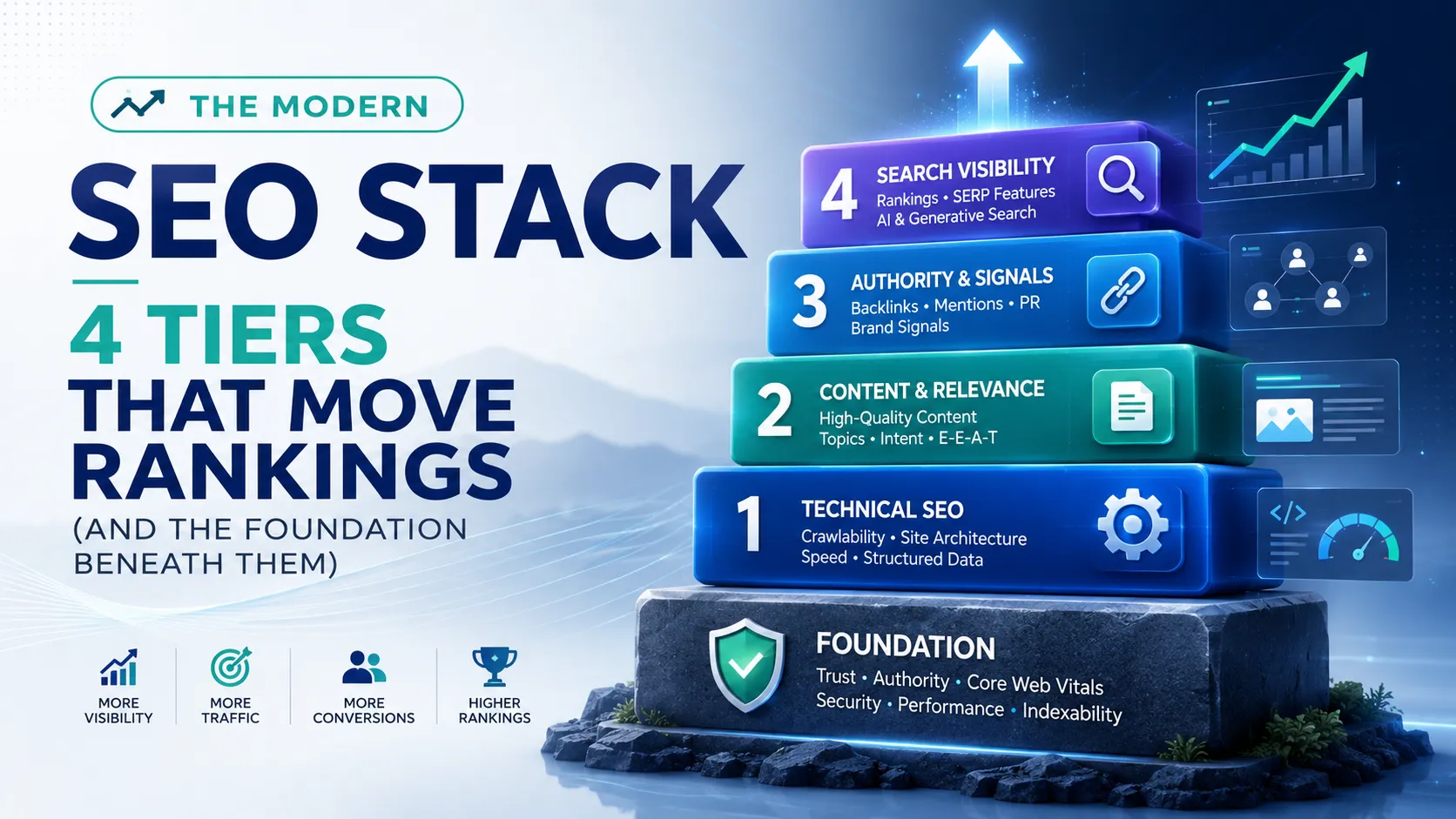
There was a time when “doing SEO” meant one tool and a spreadsheet. That era is over. Winning visibility today — across traditional search, AI Overviews, and answer engines — is the work of a stack: a set of specialized layers that each do one job well and feed into the next. Think of it as a pyramid. At the top sits the assistant that ties everything together; beneath it are the layers that supply data, audit your site, and measure what actually works.
But every pyramid needs ground to stand on, and this one is no exception. The most sophisticated SEO stack in the world still delivers nothing if the website underneath it is slow, unstable, or insecure. Below we break down the four tiers by what they do — not by any particular product — and then look at the foundation the whole structure quietly depends on.
| Tier | Layer | What it does |
| Tier 1 | AI SEO assistant | Ties the stack together — research, plan, write, and optimize in one place |
| Tier 2 | SEO research & data | Pulls SERP data, keyword metrics, backlink profiles, and competitor gaps |
| Tier 3 | Crawl & compete | Crawls pages, audits technical health, and benchmarks against rivals |
| Tier 4 | Track & ground | Monitors performance, grounds answers in real data, measures what ranks |
| Foundation | Hosting infrastructure | The fast, secure, Canadian-hosted website the entire stack depends on |
The shift to a layered stack reflects how much SEO has grown up. Keyword research, technical auditing, competitor analysis, content production, and performance measurement are each a discipline now, and no single tool does all of them equally well. Treating them as separate layers lets each one specialize — and lets the layers compound. Research feeds better content, auditing protects that content’s technical footing, and measurement tells you what to do next. The AI layer at the top increasingly stitches these together into a single workflow.
For a small business, an agency, or a startup, thinking in tiers has a practical payoff: you can see exactly which capability you have, which you are missing, and where your next investment should go — instead of buying overlapping tools and hoping.
At the apex sits the all-in-one AI SEO assistant — the layer that behaves like a tireless SEO employee. It researches topics, plans content, drafts and optimizes copy, and pulls insight from the layers beneath it. Its value is not that it replaces judgment; it is that it compresses the busywork and connects the other tiers into one place, so a marketer spends time on strategy rather than tab-switching.
The important discipline at this tier is to treat AI output as a first draft, not a final answer. Fact-check it, edit it, and add real expertise. Used that way, an AI assistant turns a solo marketer into something closer to a small team — provided the layers feeding it are giving it good data, and the site it is optimizing is technically sound.
One tier down are the research and data platforms — the layer that supplies the raw intelligence everything else runs on. This is where you pull search-results data, keyword metrics and search intent, backlink profiles, and the competitor gaps that reveal what to target. Without this layer, the rest of the stack is guessing.
Good research changes the questions you ask. Instead of “what should I write about,” you start asking “what are people actually searching for, how hard is it to rank, and where are my competitors weak.” That precision is what separates content that ranks from content that merely exists — and it is the fuel the AI assistant at Tier 1 needs to produce anything useful.
The third tier is technical: the crawlers and auditing tools that examine your site the way a search engine does. They crawl your pages, surface technical issues — broken links, indexation problems, slow pages, thin content — and benchmark your site against rivals so you can see where you stand.
This is the layer most often skipped, and it is a costly omission. You can publish brilliant, well-researched content and still underperform because search engines cannot crawl, render, or index it properly. Crawling and technical auditing protect the investment you make in the tiers above by making sure the site is actually fit to compete — which, as we will see, ties directly back to how the site is hosted.
The base tier is measurement and grounding: the analytics, search-performance data, and answer-engine monitoring that tell you what is really happening. This layer tracks traffic and conversions, shows which queries and pages perform, and increasingly monitors how your content appears in AI-generated answers. It also “grounds” the rest of the stack — anchoring decisions and AI outputs in real, verifiable performance data rather than assumptions.
Measurement closes the loop. It turns the whole stack from a set of activities into a system that learns: you see what ranks, feed that insight back up the pyramid, and improve. Skip it, and you are optimizing blind.
Here is what the pyramid model quietly assumes and rarely states: all four tiers rest on the ground your website sits on. That ground is your hosting infrastructure, and it is the true foundation of the entire SEO stack. Get it wrong, and every layer above it is undermined.
The connection is direct and measurable. Site speed and stability feed Core Web Vitals, which search engines use to assess page experience — and speed is largely a function of server performance. Uptime affects both crawlability and the visitors you worked hard to earn; a site that is slow or offline when a crawler arrives sends exactly the wrong signal. Security, in the form of HTTPS and a valid SSL certificate, is a baseline expectation. In other words, the Tier 3 audits will keep flagging problems, and the Tier 4 metrics will keep disappointing, if the foundation is weak.
This is where managed WordPress hosting proves its worth. By handling performance tuning, caching, security, and updates at the server level, managed WordPress hosting removes an entire category of technical drag — so the content your stack produces competes on merit rather than fighting its own infrastructure.
For anyone serving a Canadian audience, the foundation gets stronger still when it is local. Hosting on Canadian data centers shortens the distance between your server and your visitors, lowering latency and improving load times for Canadian users — a tangible boost to the Core Web Vitals your local audience actually experiences. It is one of the simplest performance wins available, and it is purely a hosting decision.
There is a trust and compliance dimension too. Keeping your website and customer data on Canadian data centers supports data residency and sovereignty, keeping information within Canadian jurisdiction. For businesses handling personal data, PIPEDA compliant hosting is part of responsible practice under Canada’s federal privacy law — a real consideration for Canadian SMEs and startups, not an afterthought. Choosing web hosting in Canada businesses can depend on aligns performance, privacy, and credibility in a single decision.
This is precisely where 4GoodHosting fits into the stack. As a Canadian-owned provider pairing managed WordPress hosting with Canadian data centers, 4GoodHosting supplies the foundation the four tiers stand on — so the research, content, and optimization your SEO stack produces is served on infrastructure built for Canadian performance and privacy standards. When the base of the pyramid is solid, everything above it works harder.
You do not need every tier fully equipped on day one. The smart sequence starts at the bottom and works up:
This bottom-up order respects the way the stack actually works: value flows upward from a solid foundation, and each tier pays off more when the ones below it are in place.
An SEO stack is the layered set of capabilities used to run modern SEO: an AI assistant to tie the workflow together, research and data platforms for keywords and competitor insight, crawling and auditing tools for technical health, and analytics and monitoring to measure results. Beneath all of them sits the foundation — the hosting infrastructure the website runs on.
Not immediately. The most effective approach is to start with a solid hosting foundation and measurement, then add research, technical auditing, and an AI assistant as you scale. Each tier delivers more value when the layers beneath it are already in place.
Directly and at every level. Site speed and stability feed Core Web Vitals, uptime affects crawling and user experience, and HTTPS via SSL is a baseline signal. Managed WordPress hosting addresses these at the server level, and for Canadian audiences, Canadian data centers reduce latency and improve load times — strengthening the foundation the whole stack rests on.
Two reasons. Performance: servers closer to your visitors mean lower latency and faster loads for Canadian users, improving the page experience search engines measure. Compliance and trust: Canadian data centers support data residency and sovereignty, and PIPEDA compliant hosting reflects responsible handling of personal data under Canadian privacy law.
The foundation. Fast, secure, reliable hosting delivers the highest return because it improves the results of every other tier at once. A brilliant SEO stack on a weak host is capped before it starts.
The teams pulling ahead in search are not the ones with the most tools — they are the ones who understand how the layers of an SEO stack fit together, and who build on a foundation strong enough to let those layers perform. Map your stack tier by tier, fill the gaps in the right order, and start where the return is highest: the ground the whole pyramid stands on. Get the foundation right, and every tier above it works harder.
Give your SEO stack the foundation it deserves. Explore fast, secure, Canadian-owned managed WordPress hosting at https://4goodhosting.com/ and build on infrastructure aligned with Canadian performance and privacy standards.
Phone : (866) 708-4678 (24hrs)
Local : (604) 800-9205
Fax : (866) 680-9473
4GoodHosting / R629 Enterprises Ltd.
404-999 Canada Place
Vancouver, BC
V6C 3E2
Canada
Login: Customer Support
Web: Support Ticket
Web: Support Ticket
Mail: abuse@4GoodHosting.com
 October 7, 2026Canadian Hosting, SEO, Web Hosting Canada
 October 7, 2026Canadian Hosting, Windsor Web Hosting
 October 7, 2026Canadian Hosting
 October 6, 2026Canadian Hosting
 October 6, 2026Canadian Hosting, St. John's web hosting
 September 30, 2026Canadian Hosting, Web Hosting Canada