
 August 26, 2026
 AI SEO Canada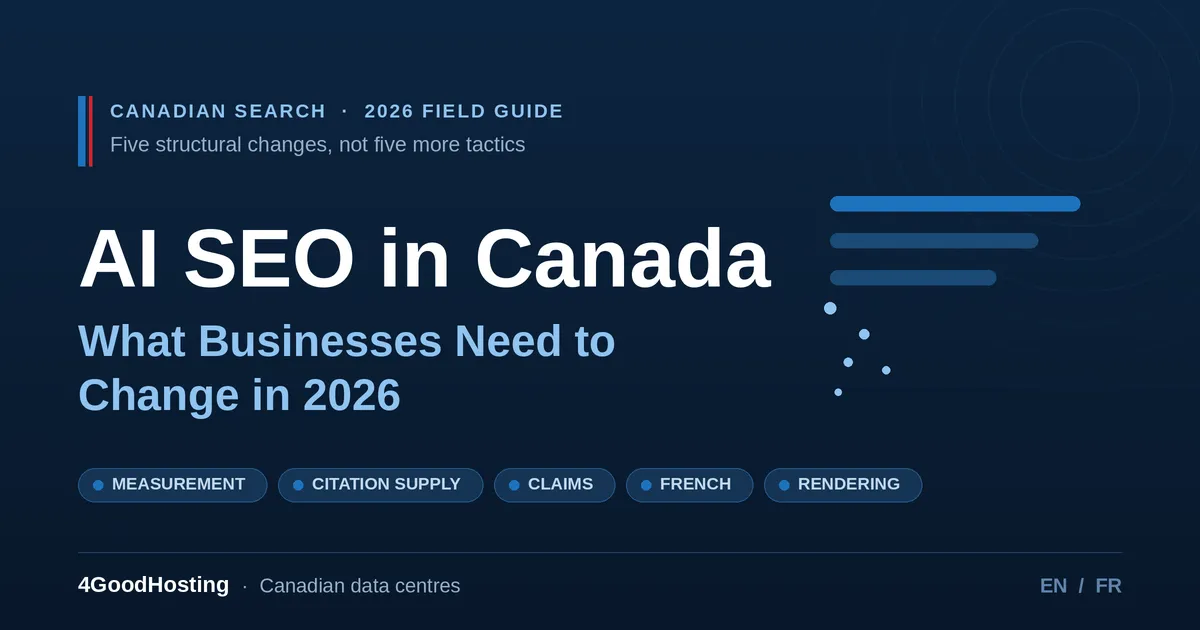
Most of the AI SEO advice reaching Canadian business owners this year was written for a different country. The frameworks are sound as far as they go — measure your visibility, publish content an answer engine can quote, earn mentions across the web, keep the technical foundation clean. What they leave out is that three of those four steps behave differently on this side of the border, for reasons that have nothing to do with marketing and everything to do with Canadian law, Canadian language obligations, and the order in which foreign regulators forced Google’s hand.
That gap is the reason the market for AI SEO services for Canadian businesses in 2026 looks so unlike the one immediately south of us. A Canadian company can follow an imported playbook precisely and still end up with unmeasurable results, mispriced earned media, and a page of comparison claims that a competitor can now take to a federal tribunal.
This is a working guide to the five things that actually need to change.
AI SEO is the practice of making a website legible, quotable, and recommendable to systems that answer questions instead of listing links — Google’s AI Overviews and AI Mode, ChatGPT, Gemini, Perplexity, and Copilot among them. It overlaps heavily with conventional search optimization, but the success condition is different. Conventional SEO asks whether you rank. AI SEO asks whether the machine that composed the answer used you, named you, and described you accurately.
That distinction matters more in Canada than the adoption numbers suggest. Statistics Canada’s Canadian Survey on Business Conditions, fielded from 1 April to 6 May 2026 across 21,105 sampled establishments, found that 19.2% of businesses used AI to produce goods or deliver services in the preceding twelve months — up from 12.2% in 2025 and 6.1% in 2024. Adoption tripled in two years, and four in five businesses still sit outside it.
The internal splits are more revealing than the headline. Urban businesses reported 21.0% adoption against 9.9% for rural ones. Businesses more than twenty years old came in at 15.0%, below the 25.0% recorded by firms three to ten years old. Information and cultural industries reached 42.3%, finance and insurance 40.4%, professional and technical services 32.4% — while construction sat at 9.2%, wholesale trade at 7.9%, and agriculture at 4.5%.
Read that as a competitive map rather than a technology report. In most Canadian sectors, the businesses that will occupy the answer layer are not competing against sophisticated rivals. They are competing against absence.
For two years the honest answer to “how visible are we inside AI answers?” was that nobody could tell you from first-party data. That changed on 3 June 2026, when Google launched Search Generative AI performance reports in Search Console, with dedicated views for Search and Discover covering appearances in features such as AI Overviews and AI Mode. Google was explicit that this data was already inside the overall performance report and is now broken out, so aggregate numbers did not change — the visibility simply became separable.
Two caveats decide how you should plan around it.
The report measures impressions. At launch it does not give you clicks, click-through rate, or the queries that triggered the appearance. You can see that a URL surfaced inside a generative feature, broken down by page, country, device, and date. You cannot see what the person asked or whether they came.
And it arrived on a rollout schedule, to a subset of properties first. Google has documented three reasons the report may not appear: the property is not yet in the rollout, the site has not accumulated enough AI impressions, or the owner opted the site out of generative features. Industry coverage tied the initial phase to regulatory pressure in the United Kingdom. Whatever the sequencing rationale, the practical position for a Canadian business is that the measurement layer for AI search is being built to a timetable no Canadian regulator is setting. You may have the report. You may not. Either way, you inherit it rather than negotiate for it.
| Question you need answered | Available in the report at launch | Where you get it instead |
| Did our pages appear in AI answers? | Yes — impressions by page | Search Console, Generative AI view |
| Which prompts triggered us? | No | Manual prompt testing on a fixed question set |
| Did AI visibility send traffic? | No clicks or CTR | Analytics referral and landing-page analysis |
| How are we described? | No | Reading the generated answers yourself |
| Are competitors cited instead? | No | Same prompt set, logged over time |
The workable response is a manual baseline that does not depend on the report existing. Write down the fifteen to thirty questions a real prospect asks before buying from you, in the words they would use. Run them across the major assistants. Log, for each: whether you were mentioned, whether you were linked, which sources were used, and how the answer characterised you. Repeat monthly. It is unglamorous and it is the only dataset that will be continuous through a rollout you do not control.
Every credible AI visibility framework says roughly the same thing about off-page work: answer engines learn about you from the rest of the web, so brand mentions, third-party coverage, comparison articles, and directory inclusion matter as much as links. That advice is correct. Its economics are different here.
Since August 2023, Meta has blocked news content on Facebook and Instagram for Canadian users in response to the Online News Act. Google took the other route, agreeing to fund Canadian journalism at $100 million annually, indexed to inflation, and was granted a five-year exemption from the Act in October 2024. As of early 2026 the federal government had signalled no intention of repealing or amending the legislation, with discussions about restoring news to Meta’s platforms continuing.
For a marketer, the consequence is specific and easy to miss. A placement in a Canadian news outlet still gets crawled, indexed, and cited normally. What it loses is one whole tier of secondary amplification — the social propagation that, in other markets, turns one article into dozens of downstream references, aggregator pickups, and follow-on citations. A U.S.-built model of what a piece of earned media is worth silently assumes that tier exists.
Practical adjustments that follow:
This is the change most likely to cause real damage, and it is almost entirely absent from imported guidance.
AI-citation content is, structurally, claim-dense content. The formats that get quoted are comparisons, category rankings, performance statements, and specific numbers. That is the whole point — an answer engine needs something extractable.
Canada changed the enforcement environment for exactly that content. On 20 June 2025, amendments to the Competition Act came into force expanding private access to the Competition Tribunal. Private parties can now seek leave to bring applications under the civil deceptive marketing provisions, subject to a public-interest test, alongside the civil agreements provisions. The Competition Bureau published a revised information bulletin on private access the same day. Deceptive marketing had already been among the Bureau’s most active enforcement priorities; the difference now is that the Bureau is no longer the only party who can act.
Layer the mechanics of AI answers on top of that. When an assistant summarises your page, it compresses. Qualifiers get dropped. “In our testing, on comparable configurations, most clients saw” becomes “clients see.” The claim that reaches the reader is blunter than the claim you wrote, and it is still traceable to your page. The Act’s civil deceptive marketing provisions also require that performance claims rest on an adequate and proper test made before the claim is made — a substantiation standard, not a disclaimer standard, and one that a footnote does not satisfy.
None of that argues for vague content. Vague content does not get cited. It argues for a discipline that most Canadian sites do not currently have:
Handled well, this is an advantage. Substantiated, specific, dated claims are precisely what answer engines prefer to quote. The compliance work and the citation work are the same work.
Quebec’s language obligations are usually filed under legal risk. In an AI search context they are also a visibility question, and the two point the same direction.
Section 52 of the Charter of the French Language requires that catalogues, brochures, folders, commercial directories, order forms, and similar publications available to the public be drawn up in French, regardless of the medium used. The regulations confirm that this covers information published on websites and social media, with the clarifying amendments to the Regulation respecting the language of commerce and business coming into force by 1 June 2025. Bilingual publication is permitted, but the French version must be at least as prominent and available on terms at least as favourable — and where separate versions exist, the French one must be of at least equivalent quality. Éducaloi, Quebec’s public legal information body, puts the operating rule plainly: a business with an address in Quebec that offers products or services to Quebecers needs a French version of its website. Enforcement sits with the Office québécois de la langue française, and the courts have upheld penalties against businesses running English-only websites contrary to section 52.
Now read “at least equivalent quality” through a retrieval lens.
Answer engines do not treat your French pages as a translation of your English ones. They treat them as separate documents competing in a separate language corpus. Machine-translated French that technically discharges a compliance checkbox tends to fail on both counts simultaneously: it is weak evidence of equivalent quality, and it is thin, derivative content in a corpus where genuinely useful French-language business material is comparatively scarce.
That scarcity is the opportunity. Google’s AI features in Canada launched in English ahead of French — AI Overviews arrived in October 2024 without French support, and language availability has been expanding since, so verify current status before planning around it. More durably, the French corpus these systems draw on skews toward European French, while Quebec French differs in vocabulary and usage in ways that matter for retrieval. A business publishing substantive Quebec French content is competing against a genuinely thinner field than the same business publishing in English.
What to actually do:
The technical layer is where the largest number of Canadian sites are quietly disqualified, and the cause is a single mismatch.
Googlebot renders JavaScript. Most AI crawlers do not. The most widely cited published test of this, a joint analysis by Vercel and MERJ of live crawler traffic, found no evidence of JavaScript execution across more than 500 million GPTBot fetches. GPTBot downloaded JavaScript files in roughly 11.5% of requests and ClaudeBot in about 23.84%, without executing them. The documented exceptions are Google’s Gemini, which rides Googlebot’s rendering infrastructure, and AppleBot, which crawls with a browser-based crawler. These are third-party measurements rather than vendor commitments, and behaviour can change — but the safe design assumption is the weakest reader, not the strongest.
The failure mode this produces is genuinely counterintuitive: a page can rank first on Google and be an empty shell to ChatGPT, Claude, and Perplexity at the same time, because the content only exists after client-side rendering.
| Crawler | Executes JavaScript | What it sees |
| Googlebot | Yes, via render queue | Fully rendered page |
| Google Gemini | Yes, shares Googlebot infrastructure | Fully rendered page |
| AppleBot | Yes, browser-based | Fully rendered page |
| GPTBot / OAI-SearchBot | No | Initial HTML only |
| ClaudeBot / Claude-SearchBot | No | Initial HTML only |
| PerplexityBot | No | Initial HTML only |
Three consequences worth acting on:
Server-side rendering is a visibility requirement, not a performance preference. If the substance of a page arrives via JavaScript, server-render it or pre-render it. For WordPress sites this is usually already true — which is a real structural advantage over heavily client-rendered stacks, and worth confirming rather than assuming, particularly for headless builds, tabbed content, accordions, and anything lazy-loaded below the fold.
Crawler access is now a deliberate policy decision. Different vendors expose different levels of granularity — Anthropic, for example, documents separate user agents for training collection, search quality, and user-initiated visits, each blockable independently in robots.txt. Google’s Search Console now also offers a control to keep content out of generative features; opting out forfeits AI impressions without affecting ordinary Search ranking. Blanket-blocking every AI crawler and then asking why you are never cited is a configuration problem wearing a strategy costume.
Response time governs what gets read. An HTML-only crawler makes one request and moves on. Slow or unreliable first-byte responses cost you inclusion rather than merely ranking. This is the point where hosting stops being a back-office decision: consistent server response, dependable uptime, and clean HTML delivery determine whether your content enters the corpus at all. For Canadian businesses there is a compounding argument for keeping that infrastructure domestic — reduced latency for Canadian visitors, data residency under Canadian law, and PIPEDA-compliant handling of customer information. Providers such as 4GoodHosting operate Canadian data centres for exactly this combination, and a managed WordPress hosting environment removes most of the rendering and performance variables from the equation before the content work starts. Web hosting in Canada is not an AI search tactic on its own; it is the layer that decides whether the tactics are readable.
If you are evaluating providers rather than doing this in-house, the useful questions are narrow. A competent engagement should be able to show you:
The market for AI SEO services for business websites in Canada is young enough that specifics are the only real signal. Treating AI search optimization in Canada for business growth as a measurable channel — rather than an add-on line item — means insisting on the method, not the dashboard.
Two counterweights, because the upside is regularly oversold.
For many Canadian businesses, AI referral volume is still small in absolute terms. If your customers arrive through referral, repeat business, or local walk-in, an AI visibility programme is not where the next dollar belongs. Statistics Canada’s own barrier data is a reasonable sanity check: 40.0% of businesses reported that AI is simply not relevant to what they produce or deliver.
And the work is cumulative rather than switchable. Entity consistency, substantiated claims, server-rendered content, and a real French corpus take quarters to build and do not respond to a sprint. The compensating benefit is that all four hold their value regardless of which assistant wins, because none of them are optimisations for a specific product.
Three things look reasonably likely over the next eighteen months. Measurement will keep improving — Statistics Canada has confirmed a new technology measurement programme, TechStat, funded in Budget 2025, with new business statistics on AI adoption and impacts beginning in 2027. French-language parity in Google’s AI features will continue to close, which raises the value of Quebec French content published before it does. And the claim-substantiation pressure will increase rather than relax, as private applications under the expanded Competition Act provisions accumulate and the standards become concrete.
None of that changes the underlying instruction. Publish things that are true, specific, and dated; make them readable by a machine that will not run your JavaScript; publish them in both official languages where you sell in both; and keep your own record of what happened, because the platform’s record is incomplete by design.
What is AI SEO?
AI SEO is the practice of optimising a website so AI-powered answer engines — including Google’s AI Overviews and AI Mode, ChatGPT, Gemini, Perplexity, and Copilot — can find, understand, quote, and recommend it. It differs from traditional SEO in its goal: being cited inside a generated answer rather than ranked in a list of links.
Can I track AI search visibility in Google Search Console?
Partly. Google launched Search Generative AI performance reports on 3 June 2026, showing impressions from generative features such as AI Overviews and AI Mode, broken down by page, country, device, and date. At launch the reports do not include clicks, click-through rate, or query data, and availability rolled out to a subset of properties first.
Why does my page rank on Google but never get cited by ChatGPT?
The most common cause is client-side rendering. Published crawler analysis indicates that major AI crawlers including GPTBot, ClaudeBot, and PerplexityBot read only the initial HTML and do not execute JavaScript, while Googlebot renders it. If your content is injected by JavaScript, Google may index it while AI crawlers see an empty page. Server-side rendering closes the gap.
Does my website need a French version?
If your business has an address in Quebec and offers products or services to Quebecers, yes. Section 52 of the Charter of the French Language covers commercial publications regardless of medium, and the regulations confirm this includes websites. A version in another language is permitted where the French version is at least as accessible and of at least equivalent quality. Businesses outside Quebec selling into the province should take specific legal advice on their exposure.
What are the legal risks of publishing comparison content in Canada?
Since 20 June 2025, private parties can seek leave to bring civil deceptive marketing applications before the Competition Tribunal, subject to a public-interest test — previously largely the Competition Bureau’s domain. Performance claims must rest on an adequate and proper test made before the claim is made. Specific, substantiated, dated claims are both lower-risk and more citable.
How does hosting affect AI search visibility?
AI crawlers that do not render JavaScript make a single request and read whatever HTML the server returns, so server response time and reliability affect whether content is read at all. Hosting inside Canada also reduces latency for Canadian visitors and keeps customer data under Canadian privacy law, which matters for PIPEDA-compliant handling.
Should I block AI crawlers?
That is a business decision, not a default. Blocking prevents your content from being used for training and retrieval, and also prevents citation. Several vendors allow granular control by user agent, and Google offers a control that excludes content from generative features without affecting ordinary Search ranking. Decide deliberately and document the decision.
Canadian businesses that get the technical and compliance foundations right are competing for the answer layer against a field that, in most sectors, has not shown up yet. That is the real case for investing in AI SEO services for Canadian businesses in 2026: not that the traffic is large today, but that the barrier to entry is still low and closing.
If you want that foundation assessed properly — rendering, crawler access, hosting performance, and the content and claim work on top of it — talk to the team at 4GoodHosting about what a Canadian-hosted, AI-readable setup looks like for your site.
 August 26, 2026AI SEO Canada, Canadian Hosting, SEO, SEO & AI Search, SEO Keyword Research, Web Hosting Canada
 August 26, 2026AI SEO Canada, SEO, SEO & AI Search, SEO Keyword Research
 August 25, 2026Uncategorized
 August 24, 2026Uncategorized
 August 13, 2026Hosting, SEO & AI Search
 August 11, 2026Hosting, Managed WordPress Hosting Canada, Web Hosting Canada